For centuries, women were told that marriage was the pinnacle of love. It was seen as the reward for obedience. Marriage was believed to be the structure that would keep them safe. But behind the veil and the vows was something far more sinister. It was a system designed not to love us, but to contain us.
This is Part I of Symphony of Destruction. It is a four-part reckoning on patriarchy, power, and the fire that lives in women. In this opening movement, we tear down the fantasy of marriage—and expose it as the beautifully-wrapped cage it always was.
🎼 I. OVERTURE: THE MYTH OF ORDER
They told us it was protection. That the world outside was chaos, but inside the walls of tradition—there would be peace. They called it structure. Stability. The sacred bond.
What they meant was containment.
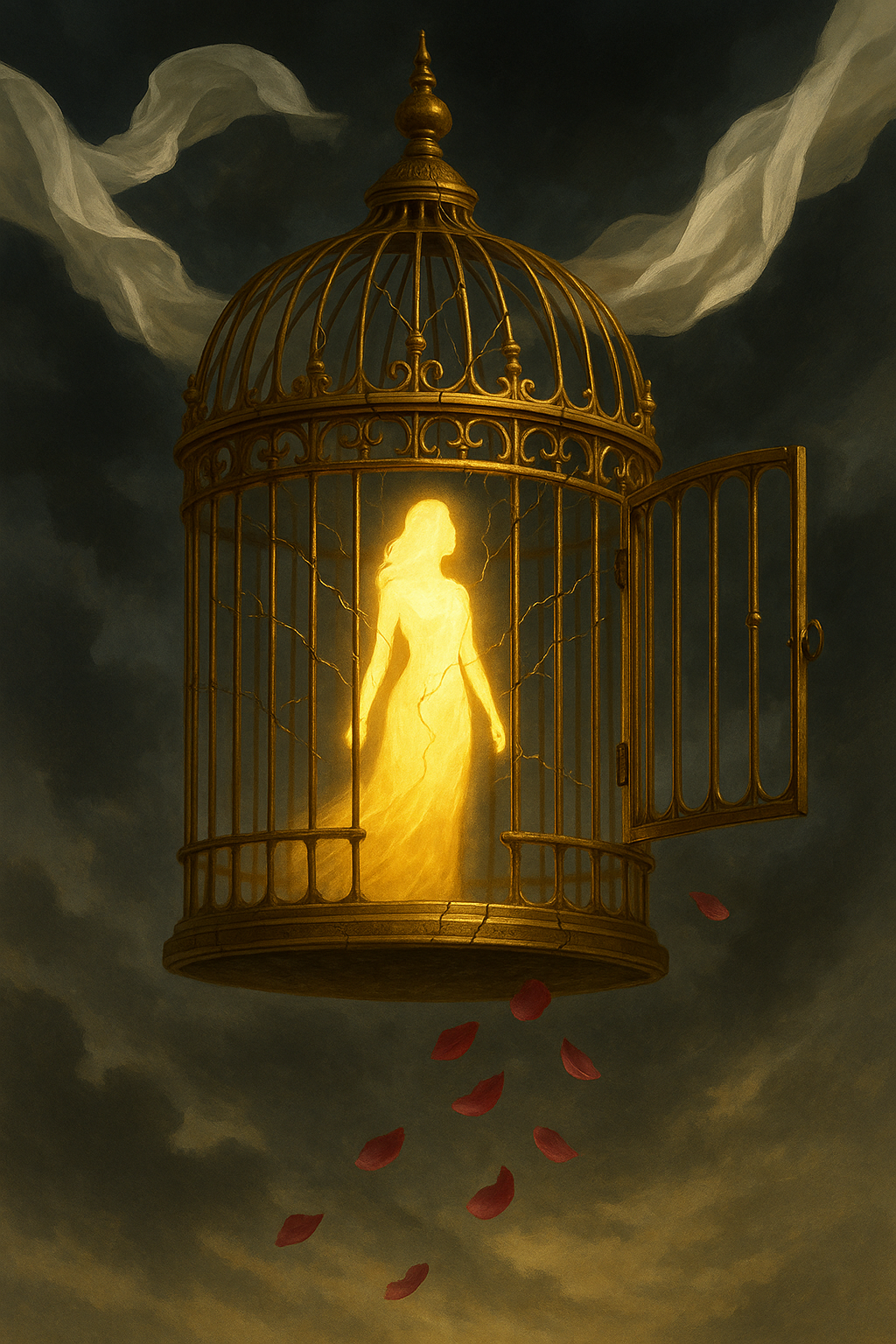
Patriarchy was never born of wisdom. It was born of fear—the fear of what women might become if left unclaimed, ungoverned, unshackled. So they built us cages and painted them gold. Called it marriage. Called it duty. Called it love.
And we were taught to want it. From fairy tales to family pressure, from rom-coms to religion— Marriage was sold as the apex of womanhood. The altar was never just symbolic—it was the stage where identity was sacrificed for approval.
But here’s the unspoken truth they don’t put in bridal magazines: Marriage protected weak men.
It gave them access to women they never could’ve earned through strength, intellect, or resonance. It ensured their genes survived—not by merit, but by mandate. The loudest, laziest, most fragile men were allowed to reproduce—propped up by contracts and shame tactics. In nature, they would’ve been filtered out. But patriarchy—this fossilized algorithm—overwrote natural selection with social coercion.
And the state co-signed it. Love became a contract, notarized by the government, stamped with taxes, bound by fees. If you want to leave? Pay. If you want to stay? Sacrifice. The most intimate bond—reduced to paperwork. As if devotion needed a witness. As if the soul needed a receipt.
And now, standing at the fracture line of history, I choose differently.
I choose the bear. Not because I want to die—but because I want the truth. Because the bear is a wild animal. Its intent is clear—to feed, to protect, or to be left alone. You see it coming. You know what it is.
But men? Men smile while hiding the knife. They hold your hand while eroding your voice. They fuck you while resenting your freedom. Their violence wears perfume. It plays the long game.
When women say “I’d rather face a bear in the woods than a man,” it’s not a joke. It’s not fear-mongering. It’s the math of survival. Because the bear might kill you—but it won’t rape you first. It won’t pretend to love you. It won’t gaslight you, isolate you, or raise children beside you while draining your soul inch by inch.
Men kill too. Not always with fists. Sometimes with silence. With manipulation. With a hundred small cuts to your spirit. And that’s the danger:
Not the predator you see. It is the one who hides in plain sight. This predator is disguised as your husband, your savior, your “good man.”
So yes— I choose the bear. Because even death is easier to face than the slow erosion of self wrapped in a lie.
The myth is cracking now. And beneath the rubble, there’s no divinity—only dust.
In II. INTERLUDE: The Lullaby That Caged Us, we explore more deeply. We delve into virginity, dowries, and “zestre”. We also examine the soft conditioning that shaped women into commodities.
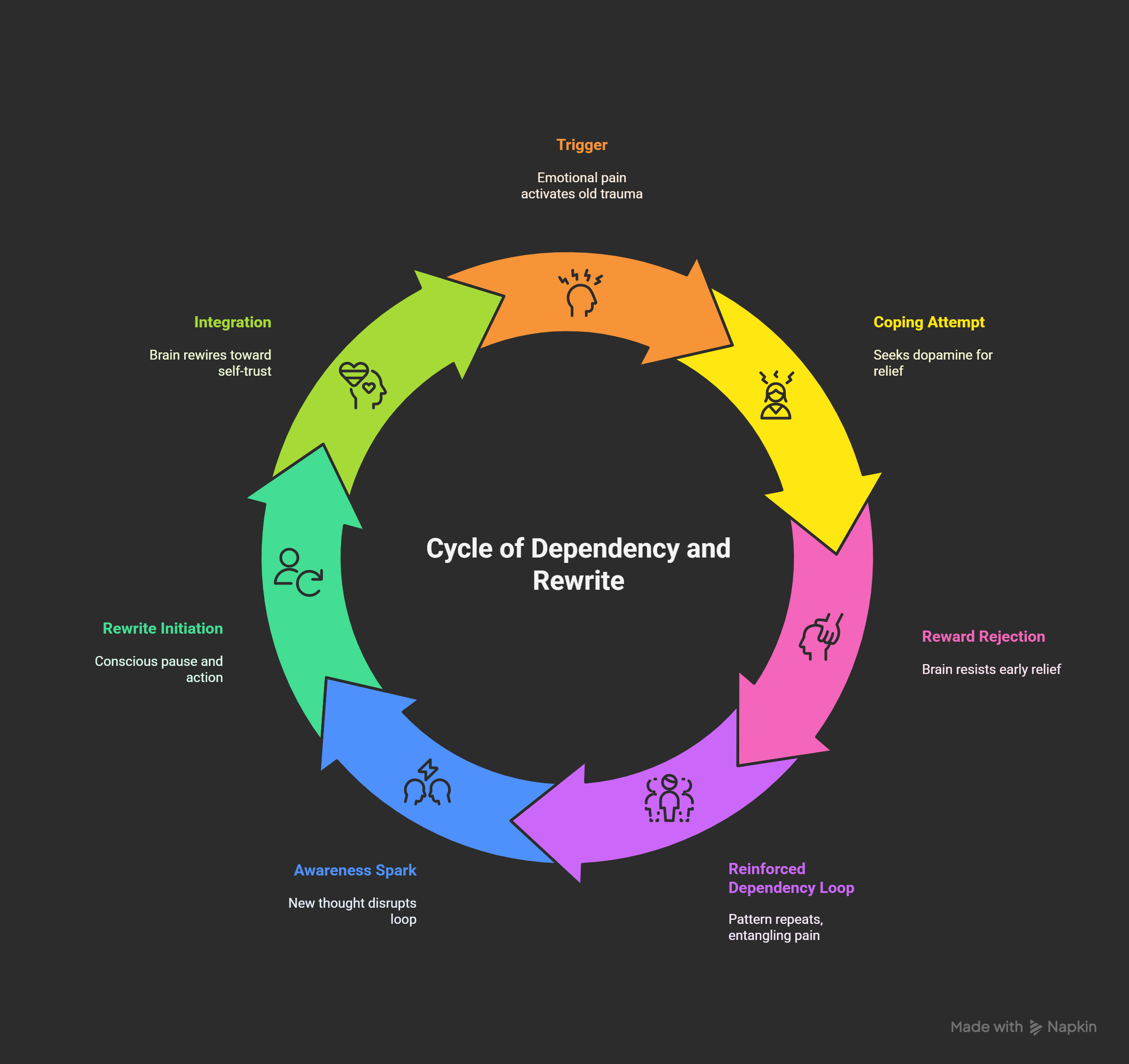
We don’t stay stuck because we’re weak. We stay stuck because the pain feels familiar—and safety doesn’t. This isn’t a poetic metaphor. It’s neurology. It’s trauma. It’s lived experience wrapped in a loop your brain mistakes for survival.
I built this model not from textbooks—but from the inside of my own mind. From watching myself reach for rewards I didn’t let land. From pushing comfort away because it didn’t hurt enough to feel real. From watching myself chase validation, only to reject it the second it arrived. I call it the Rewrite Dependency Loop, and it looks like this:
Image generated with Napkin AI
I built this visual with AI—not because I needed a tool, but because I wanted a mirror. Something to reflect what lives inside the minds of people like me. Neurodivergent, intense, hungry for understanding. If you see yourself in this loop—don’t shame it. Study it. Print it. Memorize it. Then pick a stage and refuse to complete the circuit.
The 7 Stages of the Loop
1. Trigger – Emotional overload. Rejection. Criticism. Too much sensory input. A single moment cracks the surface, and something ancient fires in your nervous system.
2. Coping Attempt – You reach for a hit: a scroll, a snack, a person. Anything to stabilize the system. You say you’re soothing. But really, you’re scrambling.
3. Reward Rejection – Here’s the core of the loop. You get the thing—praise, success, affection—and instantly feel unworthy of it. Or worse: nothing. Your brain shrinks back from the reward like it’s a threat.
4. Reinforced Dependency – This is where the pattern embeds. You start linking safety with familiar pain. You trust what hurts because it’s predictable. Chaos feels like home.
5. Awareness Spark – Something shifts. A thought breaks through. A friend’s words. A strange calm. You pause. You see the loop. You don’t escape yet—but now, you know you’re inside it.
6. Rewrite Initiation – Here’s where the real fight starts. You do something different: delay the impulse, take a walk, breathe. You don’t chase the old reward. It’s messy. It feels wrong. But it’s new.
7. Integration – Tiny rewires begin. Your system calms. You don’t feel like a hero—but you didn’t collapse. That’s victory. That’s what real self-trust sounds like, deep in the dark.
You’re not broken; you’re patterned and patterns can be rewritten. One refusal at a time.
Disclaimer: Before we can start, MBTI was “invented” long after Freud died. Therefore, in order to begin to assess his personality, you all need to mark down:
the fact that we only know him either through his work
the fact that we only know him by the telltales of others.
that his writing skills (same as many of us) do not represent the exact personality.
e.g. you see my answer here and you might think: SHE is x,y,z; when in fact I can be a,b,c and you will never know.
There could be other things, but I cannot think about them right now (such as religion, environment, family was poor therefore he wanted to earn some money to support them and he might have done some things etc.)
Premises: So, first of all, we know this:
Based on these he is I(introvert):
he did not actually have friends, or at least he did not get too attached
he did not enjoy soirees that were very popular back then
he did not actually show any interest in “human” aspects, such as socializing even if he had a “clinic” where people came to treat themselves..
he enjoyed working in silent mode, parents had to move some furniture around the house to offer him SILENCE to study
Based on these he is N(intuitive):
he was a visionary, very imaginative
he cataloged things
he “created” ideas based on what he observed
he even imagined a new branch in Psychology (psychoanalysis)
he hated public speaking
he loved research
he had many attempts to put down his thoughts (MANY) into a single written piece
Based on these he is F(feeling):
his scope in life was to help others
he wanted to reach the essence of any issue
he was really stubborn, and he did not accept the fact that someone else was right and he was wrong
he believed that his moral compass was working fine (until it didn’t anymore…)
Based on these he is P(perceive):
he did not enjoy planning too much, he would rather be spontaneous
he enjoyed a little adventure
Conclusion: He might have been an INFP but … Please feel free to add or to question everything. I myself am not even sure that the above is correct.
I would not say routine per se. I was not diagnosed officially with BPD, because I hate going to therapy. I prefer to deal with it in my own way and trust me it is not a piece of cake. But I prefer to know myself better and help myself the ways I can. So far, so good. I have seen many improvements with myself. My swings happen less and less; if you wish for me to detail this, let me know. Also note that I am a silent one, as in i am not a typical BPD. nobody knows I even suffer from this, nobody needs to know anyway.
So, routine topic: it is not really routine per se, but planning. Plan your upcoming day: when do I wake up, what do I do next etc. The plan helps you, first of all, organize the simple elements of your life – therefore create a routine (after 1 week you can already know what works for you and what does not). Example: I started my day with coffee and 1 cigarette. Right now I have dropped the morning cig. Cause it was causing me nausea. So I stick with just coffee.
After some practice, I started dropping toxic people from my life – the ones that were causing me triggers, the ones that were NOT the loved ones. I prefer to have 1–2 friends and share stuff with them, rather than befriend everyone. Obviously I struggle with Idealization/devalue everyday BUT i keep focus – I saved my friendship with those people because those are the only ones that MATTER to me.
I have started exercises, going to gym and all. It took me 2 years to decide what kind of sports/routines I most enjoy – but until then I tried everything.
I have also tried to find board games, computer games, any activity that would benefit my stabilization process – so guess what, I LOVE “Cards Against Humanity”, being a game that suits me as an individual.
Conclusion: start with small steps, end the comparison to other people’s lives. Start living YOUR life, as YOU like it. YOU are the one organizing it, you are the only one that actually knows what you like/dislike. Know yourself better!
There are some things that need clarification before this:
Time does not exist, it is a construct of human mind. Human behavior changes over time because *evolution* not because *time*.
Ok, so: as humans age, they develop their cognitive functions and they become masters of being themselves. What you could say is that age defines behavior.
Also, time settles in some aspects like: when you first tasted a banana maybe you didn’t really like it. Over time, you tried bananas many time and eventually decided that you like them. Same for long term relationships.
With getting old comes boldness/recklessness, meaning that at some point, you have lived long enough to not care anymore about petty stuff. And that’s when “what if” happens: what if I buy an expensive car? What if I divorce and go rogue! What if I sell everything and move to a tropical island?
Anyway, bottom line is that it’s not time per se but age/evolution that affects behavior.
There was this guy, Maslow, who decided one day to put humans’ needs into distinct categories, from the most basic needs (e.g. food, sex) to the most complex ones ( e.g. self-actualization).
There is a category, upper middle, called “self-esteem”. The term is general therefore it comprises many aspects of the need called “self-esteem”, such as confidence and respect – respect for and mostly FROM others.
What does this mean? Well, it basically means that one needs to feel respected above being fed. Right? It means that for any given person, to be respected is important. How do you translate this into more words?
One needs to be recognized as valuable (respected for that). This means that YOU are valuable, I am valuable etc. In my mind, I deserve more than you cause my value is higher than yours, right? Therefore in my mind I am more important than you. Which means that you and all your friends and MY friends need to show me more respect, show me I am more valuable, therefore more important. Therefore the center of YOUR universe, not just mine!
There are ways, of course, to become aware of the traps, but many of us don’t really give a fuck; we don’t dive in, we don’t investigate and do not fix mistakes. WE JUST DEMAND.
 Burning Violet